Prostken, East
Prussia: Another shooting incident
between German and Polish border officials leaves a Polish customs officer
dead.
Showing posts with label Poland. Show all posts
Showing posts with label Poland. Show all posts
Thursday, January 19, 2017

Monday, December 12, 2016
Monday, May 26, 1930: German Skirmish at the Polish Border, and Lawsuit to Stop Frick's 'Prayers of Hate'
Neuhoefen, Germany / Opalenie, Poland: German and Polish border guards exchange
gunfire in a brief skirmish that reportedly leaves one Polish soldier dead and
a German officer wounded. Each side
claims the other started it: Germany says Polish shell casings were found on its
side of the border; Poland says German blood was found on its side of the
border. Both sides promise an
investigation.
Berlin: The German
government files a lawsuit against Wilhelm Frick, the nazi Minister of
Education in the state of Thuringia, to stop the “prayers of hate” he has
introduced into schools there. From a
legal standpoint, the question is whether the federal government can interfere
in the state’s authority over its schools.
The hate prayers are one of several anti-semitic activities nazi leaders
in Thuringia have introduced.
Tokyo: Kato Hiroharu,
Chief of Naval Staff, threatens to resign in protest over Japan’s approval of
the London Naval Treaty.
London: More bad economic
news: the opposition party predicts unemployment will reach 2 million by
winter.
Wednesday, November 23, 2016
Wednesday, May 7, 1930
Berlin: Germany files a
complaint with Poland, claiming that Polish planes are flying over German
airspace, in particular over strategically sensitive areas.
Monday, November 14, 2016
Thursday, May 1, 1930: May Day Passes with Relative Calm
May Day passes relatively calmly in most of the world. Customarily a major event for labor and
communists, the day passes with less unrest than many authorities and police
had feared. Berlin is the exception:
riots and shooting mar the occasion, with one killed and 200 arrested. In Paris, police arrest more than 3,200
demonstrators or potential troublemakers, raiding meetings of communist and labor
groups to stop problems before they start, and there isn’t even much work
stoppage. Factories are running at 80%,
and utilities are normal.
In New York, 1/3 of the city’s police force – 5,000 men – are on
duty. More than 100,000 people participate
in two demonstrations – one pro-American, the other pro-Soviet, but both are
relatively peaceful. 50 are arrested for
disorderly conduct, mostly keeping kids out of school to participate in the
demonstrations. 10,000 war veterans also
demonstrate against communism.
Moscow, of course, sees its usual parades and
demonstrations. People carry signs and
banners ridiculing religion, British imperialism in India, and the League of
Nations. Loudspeakers are set up over
the Shrine of the Iberian Virgin at the entrance to Red Square, and blare
revolutionary speeches all day.
Madrid: A crowd of 10,000
cheers a speech by Miguel Unamuno, one of Spain’s leading philosophers, who
ardently advocates a republic. At one
point the crowd begins shouting, “Death to the king!” Police charge with swords drawn, injuring
50. Nevertheless, Premier Gen. Damaso
Berenguer says he doesn’t take the “shouting of students” too seriously, and
says the monarchy will remain, but elections will be held.
Warsaw: Communists and
the unemployed clash with police using guns and rocks, injuring six. Two are arrested.
Tokyo: In a press
interview, Shoza Yabuki, Vice Minister of the Navy, appeals to “everyone who
believes in party government” to support Japan’s approval of the London Naval
Treaty.
London: The worldwide
economic depression deepens: Margaret Bondfield, Minister of Labor, tells the
House of Commons that unemployment has increased more than 500,000 in a year.
Friday, April 18, 2014
Friday, 18 April 1930
Zurich: Political
exiles from fascist Italy report that political prisoners of dictator Benito
Mussolini’s government, being held in prisons on the Lipari Islands in the Mediterranean,
are being killed by their guards – two, at least, are reported dead.
Berlin: More bad economic news: reports measuring economic activity such as railway car loadings of coal and other heavy goods are all down from the same time last year.
Berlin: More bad economic news: reports measuring economic activity such as railway car loadings of coal and other heavy goods are all down from the same time last year.
Bydgoszcz, Poland:
Nine members of the Deutschtumbund, a German organization in the areas
of Poland that were taken from Germany after the World War, are sentenced to
prison for sabotaging Polish administrative decisions and spying.
Saturday, March 1, 2014
Saturday, 1 March 1930
Madrid:
Fears of everything
from a coup to a new dictatorship by either the king or new Prime Minister
Damaso Berenguer sweep the nation. The
government has prohibited political gatherings, and threatened martial law if
civil disorders continue. King Alfonso is
said to be hosting supporters from around the country to bolster his position, and
staying in contact with military generals, who are reportedly assuring him that
they support him. Meanwhile police
patrol the streets to prevent demonstrations, press freedoms are curtailed, and
those arrested in the previous days’ disorder are said to be charged with
treason. Yet rumors also fly that several
military officers are resigning and holding conference at
Barcelona – possible prelude to a coup.
Germany:
Leipzig: Police raid
a communist meeting hall and find 16 machine guns and 125 rifles that were
stolen from a nearby military barracks on Thursday. Police in a nearby village find another 6
machine guns and 30 rifles at another communist gathering place.
Berlin: Meanwhile, fighting
breaks out between nationalists and communists during a funeral for a
nationalist student who was allegedly killed by the communists. As the funeral procession is passing, the
communists reportedly jeer, and trouble ensues.
Police eventually break up the melee and the funeral continues.
Poland:
Newspaper correspondents
report a steady stream of peasants crossing the border from Russia to flee loss of land,
food shortages and villages burned at the hands of soviet authorities. Many are shot by Russian border guards as
they try to escape. One detachment of
border guards, however, reportedly joins the refugees and escapes into Poland, sick
of going hungry and being ordered to shoot their own people. Poland, however, appeals to the League of Nations for aid in helping the
refugees, as unemployment and economic conditions in Poland are already so bad
due to the depression that they fear things will get desperate.
New York:
Matthew
Woll, President of the American Federation of Labor, says the recent communist
disturbances around the country have been financed by the Communist
International, to the tune of $1.25 million.
He says the communist strategy is to take advantage of rising unemployment
to urge revolution. Additionally, federal,
state and local authorities across the nation report they’re also uncovering
evidence of major communist demonstrations being planned for March 6.
Wednesday, January 22, 2014
Wednesday, 22 January 1930
Berlin: Chancellor Hermann Meuller, after receiving a
complete report from the German delegation to The Hague Second Reparations Conference,
confirms that his government will ratify the agreement. He promises that bills necessary for
ratification will be submitted to the Reichstag next week.
Poland: Two people are killed during communist demonstrations
quelled by police.
Saturday, January 4, 2014
Saturday, 4 January 1930
Basle:
Police raid the homes of Italian communists
and anarchists living here, arresting 25 people, in advance of the train
carrying Belgian Princess Marie Jose to her wedding to Crown Prince Umberto of
Italy in Rome. This is to forestall any
possible attacks on the train, in view of anarchist plots uncovered last month.
Berlin:
The economic downturn worsens: the municipal
council stops construction on 30 buildings in the city due to the financial
crisis. “Savings first” has become a new
slogan of the city government.
Katowice, Poland:
A monument to Polish insurgents in the
1919-21 Silesian Uprisings is bombed and partly destroyed. Local authorities suspect ethnic Germans
unhappy with the division of Silesia between Germany and Poland after the World
War. The Silesian Uprisings were revolts
by ethnic Poles in Silesia seeking to join the newly created Polish state.
The Hague:
At the Second Reparations Conference, a
demand by France for sanctions on Germany should it fail to make its war
debts payments has quickly become the central topic. France insists it should have the right to
invade Germany and occupy portions of its territory if Germany fails to make
its war debt payments. Other nations,
most importantly the United States, disagree.
Germany says it’s willing to allow France the right to sanctions through
the League of Nations if Germany fails to pay its debts, but not directly.
Thursday, December 26, 2013
Thursday, 26 December 1929
Poland: News reports say Russian Catholics secretly
crossed the border into Poland on Christmas Day to attend church, given the
persecution the church has come under in the Soviet Union.
Friday, December 6, 2013
Friday, 6 December 1929
Berlin:
The
cabinet of Chancellor Hermann Mueller holds a meeting to discuss the memo that
Reichsbank President Hjalmar Schacht issued last night, which blasted them and
foreign powers for failure to meet the necessary terms of the Young Plan.
Libya:
Italian forces conducting a suppression
campaign against Libyan resistance fighters take the town of Brach by surprise
attack, without a shot fired.
Vienna:
University and high school officials, at a special meeting, decide they are closing their institutions for an indefinite period of time, in an effort to get control over the violence plaguing the schools. Socialist and nationalist students often battle each other, disrupting lectures and resulting in frequent calls to the police. And the nationalist students also battle against Jewish students and professors. Property damage from the fighting has been extensive.
Warsaw:
Communists hold demonstrations in several parts of Poland, including a group of mostly teenage boys who parade past the U.S. Embassy here, throwing rocks, breaking windows and shouting against what they call the “American intervention in the Chinese-soviet conflict.” Police arrest 5.
China:
Nanking, capital of the nationalist
government, is under martial law as the troop defections that started three
days ago have turned into full-scale rebellion.
Canton, on the southern coast, is also under martial law, with communist
rebel forces approaching, refugees pouring in, and executions and police raids
rampant. U.S. gunboats in Canton harbor
are on guard.
Friday, November 22, 2013
Friday, 22 November 1929
Manchuria:
The Russian invasion continues. The Tass news agency in Russia reports
that more than 3,000 Chinese/Manchurian soldiers have been captured. Refugees fleeing the fighting to Hailar say
1,000 Chinese/Manchurian troops and civilians taking cover from Russian bombing
in a coal mine, were killed.
Elsewhere:
Vienna: The socialist newspaper Arbeiter Zeitung publishes copies of plans by the nationalist Heimwehr
paramilitary to attack and capture Innsbruck, capitol of the Austrian province
of Tyrol. The plans called for using
poison gas, mortars and machine guns.
Warsaw: Police raid 42 apartments and find enormous
quantities of communist literature and money.
Fifty communists are arrested on suspicion of intent to destabilize the
government.
Cassel, Germany: Nationalist political leader Alfred
Hugenberg, in a speech, says his proposal to reject the Young Plan is the only
way to stop the spread of communism across the world. He says his aims in opposing the Young Plan
are to free Germany from bondage to foreign nations, and that this can be
achieved without bloodshed if only all Germans will stand together.
Friday, November 15, 2013
Friday, 15 November 1929
Krakow: Jewish and Polish students clash at a Krakow
university. The Minister of Education
orders the school closed for six months to restore order.
China: Communist rebel forces reportedly drive back
nationalist government forces in Hupeh, in central China, with fighting also still
raging in Tengfeng.
Wednesday, October 9, 2013
Wednesday, 9 October 1929: Prussia Declares Stahlhelm Illegal
Berlin:
The government of Prussia, the state that makes up some 60 percent of Germany, bans the Stahlhelm (“Steel Helmets”), a nationalist paramilitary organization, in two provinces, on grounds that it is effectively an army. The move is in response to the Stahlhelm’s support of the the Liberty Law campaign.
For months, a coalition of groups called the Reich Committee for the German People’s Petition has been campaigning, sometimes violently, for the Liberty Law, which opposes the Young Plan, would discontinue war debt payments altogether, and even prosecute government officials who support the Young Plan. The coalition was the brainchild of Alfred Hugenberg, a nationalist press baron who owns multiple newspapers, and is made up of many groups, including the German National People’s Party, a nationalist political party of which Hugenberg is head, and the radical, fascist, fringe National Socialist German Worker’s Party (nazis). The coalition was formed to drum up support for a national plebiscite on the Liberty Law, to be conducted in October. Under German law adopted after the World War, if 10 percent of voters nationwide sign a petition in favor of a proposed law, the Reichstag has to take up the measure. Hugenberg’s plebiscite is intended to gather the necessary signatures to force the Liberty Law to the Reichstag.
Also part of the coalition is the Stahlhelm, the largest of the many paramilitary organizations that operate in Germany, boasting some half a million members. President Paul von Hindenburg is its honorary president. The Stahlhelm is heavily comprised of former soldiers, and serves as an unofficial army reserve of sorts, after the standing German army was required to shrink under the Treaty of Versailles. It was pro-nationalist from its beginning, and often serves as a kind of armed wing of Hugenberg’s political party.
Prussia’s Minister of the Interior issues his ruling in reprisal for the Stahlhelm’s sometimes heavy-handed activities in support of the Liberty Law, including violence. The minister is a socialist, and much of Prussia is socialist-leaning. Prussia issues a handbill as well, stating: “The German government as well as an overwhelming majority in the German nation, realizes that the improvement in Germany’s international position cannot be forced by any German law, but is only obtainable step by step through constant efforts and negotiations with other powers.”
For months, a coalition of groups called the Reich Committee for the German People’s Petition has been campaigning, sometimes violently, for the Liberty Law, which opposes the Young Plan, would discontinue war debt payments altogether, and even prosecute government officials who support the Young Plan. The coalition was the brainchild of Alfred Hugenberg, a nationalist press baron who owns multiple newspapers, and is made up of many groups, including the German National People’s Party, a nationalist political party of which Hugenberg is head, and the radical, fascist, fringe National Socialist German Worker’s Party (nazis). The coalition was formed to drum up support for a national plebiscite on the Liberty Law, to be conducted in October. Under German law adopted after the World War, if 10 percent of voters nationwide sign a petition in favor of a proposed law, the Reichstag has to take up the measure. Hugenberg’s plebiscite is intended to gather the necessary signatures to force the Liberty Law to the Reichstag.
Also part of the coalition is the Stahlhelm, the largest of the many paramilitary organizations that operate in Germany, boasting some half a million members. President Paul von Hindenburg is its honorary president. The Stahlhelm is heavily comprised of former soldiers, and serves as an unofficial army reserve of sorts, after the standing German army was required to shrink under the Treaty of Versailles. It was pro-nationalist from its beginning, and often serves as a kind of armed wing of Hugenberg’s political party.
Prussia’s Minister of the Interior issues his ruling in reprisal for the Stahlhelm’s sometimes heavy-handed activities in support of the Liberty Law, including violence. The minister is a socialist, and much of Prussia is socialist-leaning. Prussia issues a handbill as well, stating: “The German government as well as an overwhelming majority in the German nation, realizes that the improvement in Germany’s international position cannot be forced by any German law, but is only obtainable step by step through constant efforts and negotiations with other powers.”

Stahlhelm with old imperial flag
Moscow:
Pravda, newspaper of the communist party, launches a new occasional feature titled, “To Know Our Enemies in Order to Hate them.” It’s a review of capitalist countries, with the United States winning the honor of being evaluated first. “Millions of European proletarians who sought freedom and happiness on American farms are disillusions after paying a bitter price. Farmers are being reduced to beggars. Taxes aggregate 30 percent of the value of farm production, while from four to five million workers are permanently unemployed. Workers do not get vacations. They are given no means to support themselves properly, and are likely one morning to find their jobs gone when they return to work. Millionaires’ daughters order colored limousines to match every new gown.”
“Hence we must imbue communists with a real hatred for capitalists so that communists will fight harder. Those American communists who refuse to believe in the inherent rottenness of American capitalism are being expelled. Business is their god, money their king and commerce their ruler; but, as churches and thrones were crushed, so this American paradise will be crushed.”
Harbin, Manchuria:
The U.S. consulate here receives a report from Leonard Lilliestrom, U.S. Vice Consul, confirming reports of atrocities by Red Army soldiers against White Russians in Hailar and Manzhouli. Among the gruesome details: soviet cavalry has surrounded villages and forced males over 10 to the edge of town where they are mowed down with machine gun fire. An estimated 150 White Russians have been killed by the soviets.
Elsewhere:
Jaryczowo, Poland: Anti-semitic unrest among ethnic Ukrainians
flares into violence and death. Last
night a mob of Ukrainians attacked a synagogue during evening prayers,
resulting in four Ukrainians killed and 11 Jews and 5 Ukrainians injured as the
Jews fought back with candlesticks and furniture. Today a large Ukranian mob attacks Jewish
merchants, wounding 7, vowing revenge for the deaths of their kin. Police are out in force, as both groups are
heavily armed.
Hungary: Jewish students are beaten in schools after distributing handbills. Schools in Hungary have been known to ban Jewish students from classes with Hungarians, and Jews who protest this can face mistreatment.
Sunday, October 6, 2013
Sunday, 6 October 1929: USA and Great Britain Announce London Naval Conference
Madison, Virginia, USA:
President
Herbert Hoover and British Prime Minister Ramsay MacDonald, conferring at Hoover's private Rapidan Lodge, jointly announce
they will invite five world powers to a naval conference in London in January 1930. Purpose will be
resumption of talks on parity and caps in naval fleets of the U.S., Great
Britain, France, Italy and Japan.
Negotiations had been going on for six months between the countries about such a gathering. A previous naval treaty was signed in 1922 among the five nations -- all victors in the World War (accordingly, neither Germany nor Russia are to be invited to the conference). That treaty was intended to limit the construction of new navy "capital ships" -- battleships, heavy cruisers and aircraft carriers -- in an attempt to prevent an arms buildup that might contribute to another war. This conference would revisit those terms.
Negotiations had been going on for six months between the countries about such a gathering. A previous naval treaty was signed in 1922 among the five nations -- all victors in the World War (accordingly, neither Germany nor Russia are to be invited to the conference). That treaty was intended to limit the construction of new navy "capital ships" -- battleships, heavy cruisers and aircraft carriers -- in an attempt to prevent an arms buildup that might contribute to another war. This conference would revisit those terms.

Bucharest:
Government officials say they suspect yesterday's assassination attempt on Alexandru Vayda-Voevod, Minister of the Interior, was intended to be the start of a broader campaign of communist unrest in Romania and throughout the Balkans. Authorities say soviets recently held a conference at Odessa, Soviet Union, to discuss agitation in the Balkans in the wake of the failure of "International Red Day," August 1, on which the West European Bureau of the Communist International (COMINTERN) had called on workers throughout the world to hold demonstrations in the streets. At this Odessa conference, Romanian authorities charge, the communists laid plans to join forces with autonomy movements in the Transylvania and Bessarabia regions of Romania, in an attempt to bring about revolution. The government orders extra police guards at public buildings.
Warsaw:
Socialist demonstrations on Socialist Youth
Day against the government of Josef Pilsudski turn into a riot. Police move in to restore order and arrest
the demonstration’s leaders.
Wednesday, October 2, 2013
Wednesday, 2 October 1929
Moscow:
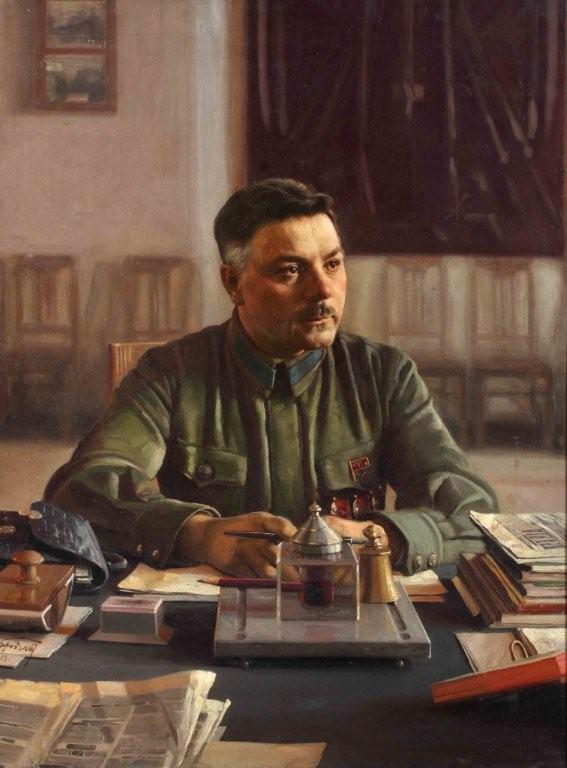
Klementi Voroshilov, Commissar of War, gives a bellicose speech before a regional trade union conference, in which he predicts that a massive war is coming between the “capitalistic” powers and the Soviet Union. But he appears to welcome it, saying it will be the only way for the Soviet Union to deal with its enemies. “In a future war, our air force working in collaboration with an immensely powerful artillery and utilizing chemical means of destroying life will play a decisive role. The Red Army is already strong enough in all these branches to beat all its probable enemies, but considering that the enemy powers will be stronger industrially, we cannot rest content with the present munition supply either in respect to quantity or quality. The foundation of the munition supply and technical power lies in the trade union movement. The next war will be decided by workers in the factories, professors in the laboratories and students in the higher technical schools.”
Nowa Slupia, Poland:
A large but incidental fire destroys 70 houses and two synagogues . . . and reaches stores of explosives hidden in the basement of a building used for communist meetings, rocking the town with huge explosions. Communists then cut the water mains to hamper fire control efforts, and attack firefighters and police with knives. It takes 24 hours and the arrest of 11 communists to get the situation under control. Five are killed and 100 more severely burned. Police say the basement was being used as a supply center for communist militants in southern Poland.
Lima:
Meanwhile, allegations of communist agitation in Peru. The newspaper La Prensa prints an article which says a
communist plot against the government has been discovered in the army, and
several officers are due to be court martialed as a result. “A few subaltern officers as well as a
comparatively considerable number of sergeants and corporals were arrested,”
the article says.
Subscribe to:
Posts (Atom)