Showing posts with label France. Show all posts

Monday, January 30, 2017

Monday, June 30, 1930: French Troops Evacuate the Rhineland

Mainz, Germany:  “Amid tremendous outbursts of enthusiasm of the populace, the last hobnailed boot of foreign troops vanished Monday from German soil.”  So leads the Universal Press article describing the scene in Mainz, throughout the Rhineland, and over much of Germany, as the last French forces occupying German soil after the World War depart.  At 11:15 a.m., the French flag is hauled down from the old Mainz castle, and the last several hundred French soldiers march to the train station to depart.  Some Germans cheer.  But at the train station, a crowd hisses and boos the departing troops.

The German government issues a statement tonight which reads in part: “There are still heavy clouds overhanging the political and economic life of our people.  The present day, however, gives reason for hope in the future.”  President Paul von Hindenburg refers to the occupation as “arbitrary foreign rule” in his comments.


Church bells are rung for an hour all over Germany, and public offices are closed.  At nightfall, bonfires are lit on the banks of the Rhine, and people celebrate into the night.
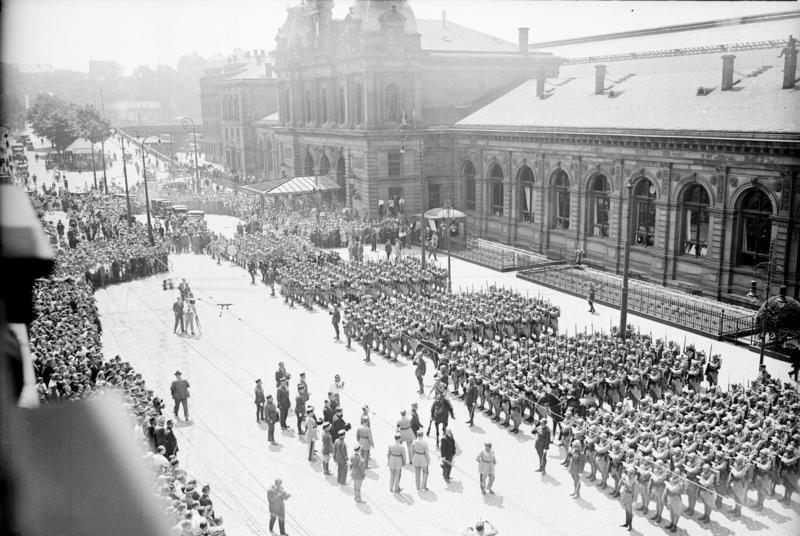

Paris:  The French press, on the other hand, worries that in the midst of their celebrations (and boos), Germans have not appreciated the fact that France is withdrawing its troops earlier than originally agreed.  Some even predict that Germany’s fascists – the nazis of Adolf Hitler – will grow in influence without a French presence.  


Matamoros, Mexico:  Twenty people are killed and eight more wounded when a mob of communists battles police in this central Mexican city.  The communists had sought permission for a march of protest against the Mexican government’s arrest of communists in other parts of the country.  When they were refused, they marched anyway.  Press reports say the communists opened fire on police.

Bilboa, Spain:  Communists are also implicated in two bomb blasts that destroy houses under construction here.  No one is injured.  Police, who seize two alleged perpetrators after a gun battle, say the bombs were an attempt to incite a general strike.

Thursday, January 26, 2017

Thursday, June 26, 1930: French Troops Evacuate The Palatinate

Speyer, Germany:  French troops depart The Palatinate, a region of about 2,100 square miles in southwestern Germany that has been occupied since the World War.  Residents celebrate by removing French-language street signs.  By prior agreement, all French troops will be out of the Rhineland by June 30.

Moscow:  The communist party’s annual convention opens at the Moscow Grand Opera House with speeches urging communists in the United States to agitate for revolution.

Washington:  Secretary of Commerce Robert P. Lamont releases census figures which indicate unemployment is just under 2.3 million, better than widely thought.  William Green, President of the American Federation of Labor, says unemployment is 3.6 million.

Berlin:  Herman Dietrich is appointed Finance Minister to replace Paul Moldenhauer, who resigned June 18.  Moldenhauer’s financial reform proposals proved unpopular.  Dietrich was Minister of Economics in Chancellor Heinrich Bruening’s cabinet.  Political observers say Dietrich’s appointment is Bruening’s last chance to save his government.

Budapest:  A group of 30 communists attacks the Polish Embassy with stones, smashing windows and shouting, “Down with Polish dictatorship!”  This after Poland executed a group of communists at Lwow (Lviv).  Police disperse the mob and arrest some.

Friday, January 20, 2017

Friday, June 20, 1930

Berlin:  The resignation of Finance Minister Paul Moldenhauer is causing the first crisis for Chancellor Heinrich Bruening’s cabinet, which can’t agree on who should replace him.  Bruening still maintains that an emergency tax is the only solution to Germany’s financial situation, but the unpopularity of this idea is partly what caused Moldenhauer to resign.


Paris:  More bad economic news -- French foreign trade shows a deficit of 3.3 billion francs for the first five months of the fiscal year.  Yet on the same day, sources say Prime Minister Andre Tardieu will propose a 1 billion franc increase in defense spending, saying the country’s defense funds have become depleted.

Wednesday, January 18, 2017

Wednesday, June 18, 1930: European Backlash to Smoot-Hawley

London:  Protest and complaint come fast and fierce to the U.S. Smoot-Hawley tariff act.  Critics say it will jeopardize Britain’s war debt repayments to the U.S., and demand that Great Britain raise tariffs to protect her industries in turn.

Paris:  Newspapers and politicians of all stripes denounce the U.S. tariff act.  The Minister of Commerce calls it a “false remedy” for the worldwide economic depression.  French economists are calling for a European “tariff union” to offset the U.S. measure. 

Madrid:  The government orders a committee to study the effects of the U.S. tariff.  Critics are calling for Spain to break its current trade agreement with the U.S. in retaliation.


Berlin:  Finance Minister Paul Moldenhauer is reportedly resigning in the face of widespread disfavor for his financial reform measures, such as new taxes on employees and bachelors.  The cabinet of Chancellor Heinrich Bruening meets in special session tonight to discuss the matter.

Friday, January 6, 2017

Thursday, June 5, 1930

Germany:
Berlin:  Chancellor Heinrich Bruening’s cabinet proposes a plan to rescue Germany’s ailing finances by an emergency 10% tax increase on workers’ salaries, on fees earned by corporate directors, and on . . . unmarried men.  The latter is being called the “bachelor tax.”  How popular this idea will prove remains to be seen.

Nienburgh:  More evidence of the depression’s toll.  Farmers in this northern community tear up paving and barricade two streets into their village, wielding clubs and pitchforks, to prevent tax bailiffs from serving notice of non-payment on drainage assessments.  No violence breaks out; the bailiffs leave without delivering their notices.

Nice:  French authorities expel an ethnic Italian fascist for his role in sending a group from Nice’s Italian community to Rome as representatives of “Italian provinces and dominions” at a ceremony there.  That Nice is not an Italian province seems clear to the French.  But many in Italy still consider Nice and Savoy lost territories from the last century, before Italy’s unification.

Bucharest:  Romanian police uncover a widespread soviet propaganda organization in Bessarabia, the northeastern region which Romania has governed since 1918, but which Russia still considers her territory.  Police say the network had 16 centers, intended to agitate for the region’s communization and unification with the Soviet Union.

Thursday, December 8, 2016

Thursday, May 22, 1930

Vienna:  New information on Chancellor Johan Schober: he is not resigning, but rather is reportedly planning to move forward with submitting to parliament a bill to disarm Austria’s paramilitaries, ignoring the Heimwehr’s conditions for doing so.  It is a bold, risky political game, but one Schober appears to be winning: leading politicians who were aligned with the Heimwehr are reported defecting, emboldening the chancellor.
 

Berlin:  The German public is incensed as it comes to light that France has demanded the destruction of three large airship hangars at Griesbach, considering them a threat to French security.  

Tuesday, December 6, 2016

Tuesday, May 20, 1930

Ludwigshaven, Germany:  Consistent with yesterday’s announcement, the commander of French forces occupying the Rhineland gives orders for the first 2,000 troops to prepare to leave.  A total of 40,000 troops will evacuate by June 30. 

Prague:  A socialist newspaper alleges that Italian dictator Benito Mussolini has plans to put Otto von Hapsburg, the last crown prince of Austria-Hungary, on the throne of Hungary as part of his designs to dominate eastern Europe. 


Milan:  Meanwhile, “Il Duce” keeps up the speechmaking.  At a ceremony honoring the fascist dead and inaugurating a new headquarters for the fascist party here, Mussolini calls fascism the “hope of Europe.”  

Monday, December 5, 2016

Monday, May 19, 1930

Tokyo:  Admiral Takarabe Takeshi, Minister of the Navy, is given a dagger with the recommendation that he use it to commit suicide to expiate the “crime” of his agreeing to the London Naval Treaty.  He doesn’t.  In fact, he publicly refuses today an earlier demand that he resign over the treaty.  Meanwhile, a naval officer does commit suicide to express his bitterness and despondency over the treaty.  Lt. Commander Eiji Jusakari, attached to the naval general staff, slashes his abdomen with a sword while on a train from Kobe to Tokyo.  He dies in a hospital where he is taken en route.

Paris:  An all-but-forgotten German-French committee discussing the return of the Rhineland to German control announces success: they have reached full agreement on withdrawing the last occupying French troops by June 30.  Separately, French officials burn US$37 billion worth of German bonds in a symbolic gesture illustrating the liquidation of all past reparation efforts, in view of the superseding Young Plan.


London:  The worldwide economic depression worsens: officials announce British unemployment has reached 2.5 million.  Just last week it was being announced at 1.7 million.

Saturday, December 3, 2016

Saturday, May 17, 1930

Florence:  Dictator Benito Mussolini, after months of relative quiet, gives a bellicose speech before 200,000 screaming fascists, emphasizing the military might of Italy and her readiness to battle her enemies.  “There are people who think they can isolate Italy, and who would not be adverse from starting war against the Italian people, even through the territory of a third power.”  It is widely understood that Mussolini refers to France, whose relations with eastern European countries, Italy believes, are intended to isolate Italy.  “Fascist Italy henceforth will be a unit so organized as to be unassailable and without mortal danger.  Though words are beautiful things, rifles, machine guns, ships, airplanes and big guns are still more beautiful.” 

The French Ambassador to Italy visits Italian Foreign Minister Dino Grandi to express his displeasure. 

Paris:  Foreign Minister Aristide Briand has presented a proposal to the 26 European countries that are members of the League of Nations, calling for a federation of European states.  Some in the U.S. press are calling the idea a “United States of Europe.”  Briand first floated the concept in a speech last year, but now has presented it, fully formed, in a “Memorandum on the Organization of a Regime of European Federal Union.”  It is a bold proposal, though not without some precedent in European history.  Some fear Italy and Germany will view it as an attempt to isolate them and expand French influence over the continent.

Berlin:  Three people are killed when communists and nazis, on their way home from various political gatherings, clash in street brawls.


New York:  Police battle a crowd of 2,000 communists when they attempt to free picketers who had been detained after ignoring a court injunction not to demonstrate.  Four are arrested.

Wednesday, April 30, 2014

Wednesday, 30 April 1930

Paris:  France expels 22 communist leaders as a precaution against May Day agitation tomorrow. 

Monday, April 28, 2014

Monday, 28 April 1930

Vienna:  The Austrian government announces that 15,000 Austrian laborers who were to be employed by France to help build defensive fortifications there, cannot be used to work on fortifications directed toward Germany. 

Friday, April 25, 2014

Friday, 25 April 1930: Opposition to London Naval Treaty Rises in Japan

Tokyo: 

Opposition to Japan’s approval of the London Naval Treaty arises quickly.  Inukai Tsuyoshi, President of the Seiyukai opposition political party, attacks the treaty in the diet, claiming that because it was signed by a civilian government representative, it violates the Japanese constitution, which stipulates that the military be free from civilian control.  Foreign Minister Kijuro Shidehara, reviewing the treaty in the Diet, repeatedly has to refute the accusation that the Japanese delegation was forced to sign. 


Inukai Tsuyoshi


Paris:  Prime Minister Andre Tardieu proposes severe measures to prevent communist demonstrations on May Day, May 1. 

Halle, Germany:  A clash between nazis and communists after a nazi meeting results in injuries to 19 nazis. 

Monday, April 14, 2014

Monday, 14 April 1930

Germany: 

Wilhelm Frick, nazi Minister of the Interior and Education in the state of Thuringia, issues an order that will revoke the licenses of entertainment establishments that present black performers or their music.  Frick says he is acting to save Germany from “negro culture,” which he says is corrupting morals in the country.


Berlin:  New Chancellor Heinrich Bruening’s package of financial reform bills (mostly taxes) and agrarian relief passes the Reichstag by slim margins – in the case of the budget bill, by just four votes.  Bruening’s authority to dissolve the Reichstag, granted him by President Paul von Hindenburg, again looms large over the proceedings, with political parties sending cars and in some cases even planes out to bring legislators in for the vote, rather than face elections for a new parliament.  The measures implement new taxes on tobacco, sugar, beer and mineral water. 

Elsewhere:

Paris:  Two fascists are shot to death in the street by communists in revenge for recent arrests of communists in France.

New York: The Rand School of Social Science, a socialist institution, releases its American Labor Year Book for 1930, which states that the growing worldwide unemployment problem caused by the Great Depression is worst in Russia.

Monday, March 24, 2014

Monday, 24 March 1930

Paris:  

In the case of White Russian General Alexander Koutiepoff, missing since allegedly being kidnapped in broad daylight January 30, a newspaper claims to have proof that he is in prison in the Soviet Union.  La Liberte writes, “We have awaited the moment when the secret service has received official confirmation of the above facts in order to make them public.  We can now affirm that Koutiepoff six days ago was alive in the Lubyanka jail in Moscow.”  An accompanying editorial urges the French government to sever relations with the Soviet Union over the incident. 

Geneva:  The tariff truce conference that opened here last month ends with 11 European nations agreeing to limited restrictions on their protective tariffs.  The hope is that this will stimulate the economies of Europe, most of which are trending downward in the worldwide depression.

Saturday, March 22, 2014

Saturday, 22 March 1930

England:

London:  At the naval conference, a scheduled meeting between British Prime Minister Ramsay MacDonald and French Prime Minister Andrae Tardieu is cancelled, signaling definitively that France is out of the parley.  After two months of meetings, the conference is at a complete standstill – with nothing to show for its effort -- as Great Britain and the U.S. await word from Japan on whether a 3-way pact can still be signed.  Many in the press are saying the conference will have been a complete failure if Japan’s reply is negative.

Manchester:  More evidence of the Depression’s spread: an estimated 25% of cotton operatives in Lancashire are out of work, some so destitute they can’t get food to eat. 

Elsewhere:

Paris:  Finance Minister Paul Reynaud, in a committee speech, says that barring unforeseen circumstances, he expects France will remove all forces and end its occupation of the Rhineland by June 30.

Moscow:  Tens of thousands of demonstrators march for three hours here and in other cities around Russia in protest against religion.  

Friday, March 21, 2014

Friday, 21 March 1930

Manchuria:  

Warlord Zhang Xueliang, effective ruler of Manchuria, offers his services as mediator between Chinese President Chiang Kai-shek and rebellious Governor Yen Hsishan of Shansi.  The threat of renewed civil war in China has been looming for weeks.


London:  

The French delegation appears to withdraw from the naval conference, having left for Paris for the weekend and announcing that they won’t be back.  Observers think it’s a ploy to try to wrest an 11th hour concession out of either Italy (to give up its demand for naval parity with France) or England (for a naval deal that includes continental security).  But Great Britain, the U.S. and Japan evidently saw this coming, and reportedly have a three-way “fallback” pact they will go to work on.  It is expected that if France is out, Italy will be too, as Italy presumably would not agree to any limitations on naval power with France under no such obligation.

Chisinau, Romania:  

Russian and Romanian border guards get into a firefight on the Dniester River near here.  According to reports, the Russian guards board a boat on their side of the river, then cross over and attack the Romanian border post with hand grenades.  The Romanians respond with rifle fire.  One Romanian is killed and several Russians wounded.  No one knows a reason for the attack, but tensions relative to Russia are high in Romania, as the government says it has uncovered communist plots to attempt a coup in the country.

Elsewhere:

Moscow:  Crowds of Young Communists and Young Pioneers (a communist version of the boy scouts) converge on the Italian Embassy and hold protests against the Pope. 

Bogota:  Thousands of unemployed conduct a demonstration that devolves into a riot when police fire on the crowd.  Two are killed and at least 20 injured.

Monday, March 17, 2014

Monday, 17 March 1930

Paris:  The negotiations between France and Germany over the Saar region are suspended after five months of on-again off-again meetings that have thus far produced few results.  Reason given is that France wants to wait for the London Naval Conference to end before resuming.

Moscow:  The Godless One, newspaper of Russian atheists, calls for anti-religion demonstrations to “counteract” the Pope’s call for Catholics to pray on Wednesday for the persecuted church in Russia.

Monday, March 3, 2014

Monday, 3 March 1930

Berlin -- Paris:  Authorities report that they, like their counterparts in the United States, are getting word of massive communist and unemployed demonstrations being planned for March 6.

New York:  Matthew Woll, Vice President of the American Federation of Labor, says “Communists are purposely planning to start riots here so police will be forced to interfere to maintain order.  Women and children sympathizers of Soviet Russia will be placed in the front ranks in the red demonstrations.  Then when the police put down the riots, the soviet sympathizers will cry: ‘Police are Cossacks! They ride down women and children.’”

Sunday, March 2, 2014

Sunday, 2 March 1930

Moscow:  

Joseph Stalin issues an article, titled “Dizzy With Success,” published in newspapers around the Soviet Union, which appears to call for a slowdown – a “consolidation” -- in the soviet assault on the lives of peasants, including their religion.  Stalin says overzealous prosecution of anti-religious activity stems from overconfidence, and he warns against it.  “I say nothing of those ‘revolutionaries” . . . who begin the work of organizing artels [a cooperative association] by removing the bells from the churches.  Just imagine removing the church bells – how r-r-revolutionary!  How could there have arisen in our midst such blockheaded exercises in ‘socialization,’ such ludicrous attempts to overleap oneself, attempts which aim at bypassing classes and the class struggle, and which in fact bring grist to the mill of our class enemies?  They could have arisen only in the atmosphere of our ‘easy’ and ‘unexpected’ successes on the front of collective-farm development.  They could have arisen only as a result of the blockheaded belief of a section of our party: ‘We can achieve anything!  There’s nothing we can’t do!’  They could have arisen only because some of our comrades have become dizzy with success and for the moment have lost clearness of mind and sobriety of vision.  To correct the line of our work in the sphere of collective-farm development, we must put an end to these sentiments.  That is now one of the immediate tasks of the party.” 

Observers hope this may signal an easing of religious persecution in Russia. 

Elsewhere: 

Germany:  The worldwide economic depression worsens: unemployment in Germany has grown to 2.34 million. 

Paris:  Andre Tardieu is named Prime Minister, barely more than a week after he fell from the same post. 


Wednesday, February 26, 2014

Wednesday, 26 February 1930

United States:  

The unemployed, spurred on in many cases by communist organizers, riot or demonstrate in various parts of the country.  In Los Angeles, an estimated 3,000 people march on city hall, bearing banners reading “down with the police” and “forever the worker,” and wielding homemade tear gas bombs.  They are charged and dispersed by 300 police, and 27 are arrested.  In Chicago, several hundred people attending a communist meeting at Musicians’ Hall are encircled by police, allowed to give speeches and distribute communist literature, part of which attempts to incite a march of the unemployed -- then the police arrest every one of them.  A similar demonstration in Seattle is also broken up by police, with 11 arrested, and in Boston, where 9 are arrested after a strike called by the communist faction of the garment workers union.  The banners in Seattle read “down with capitalism” and “work for wages,” and handbills are signed by the Communist Party of the United States.  The handbills urge unemployed people to join a worldwide demonstration against capitalism.  Several hundred alleged communists also parade down Wall Street in New York. 

Elsewhere: 

Leningrad:  Police arrest Rabbi Lazerev, Chief Rabbi of Leningrad, and his colleague Rabbi Yasnogorowski, charging them with illegal connections abroad.
 
Berlin:  Paul Moldenhauer, Minister of Finance, proposes doubling the gasoline tax (called “benzine” in Germany) to 12 cents a gallon, and increasing the beer tax 75%, in hopes of raising the equivalent of US$110 million to help Germany’s budget deficit. 

Paris:  Andre Tardieu, former Prime Minister, agrees to return to the post after Camille Chautemps’ cabinet fell on its first vote in parliament.