Monday, March 31, 2014

Monday, 31 March 1930

Moscow:  The government exiles 90 Jews to Siberia for participating in groups the state deems illegal; 55 more are forced to sign statements promising not to leave Moscow and to discontinue their memberships. 

London:  The British fiscal year closes with a deficit of 14.5 million pounds, more than 18 million pounds below budget, due to the economic downturn.  Meanwhile, some 1,200 companies in the wool industry post notices of wage reductions, effective next week, due to the economic conditions. 

Sunday, March 30, 2014

Sunday, 30 March 1930

Germany:

Berlin:  Alfred Hugenburg, nationalist political leader, is protesting loudly about the new government of Heinrich Breuning.  He claims Breuning’s cabinet is illegitimate, and that the Reichstag must be dissolved and new elections held.  So far, President Paul von Hindenburg is ignoring him. 

Leipzig:  The government enters a charge of high treason against Wilhelm Frick, nazi Minister of the Interior of Thuringia, on charges that he is seeking to reorganize the police in that state (over which his post has authority) along nazi lines of thought.  The public prosecutor will begin an investigation into the charge. 

Saturday, March 29, 2014

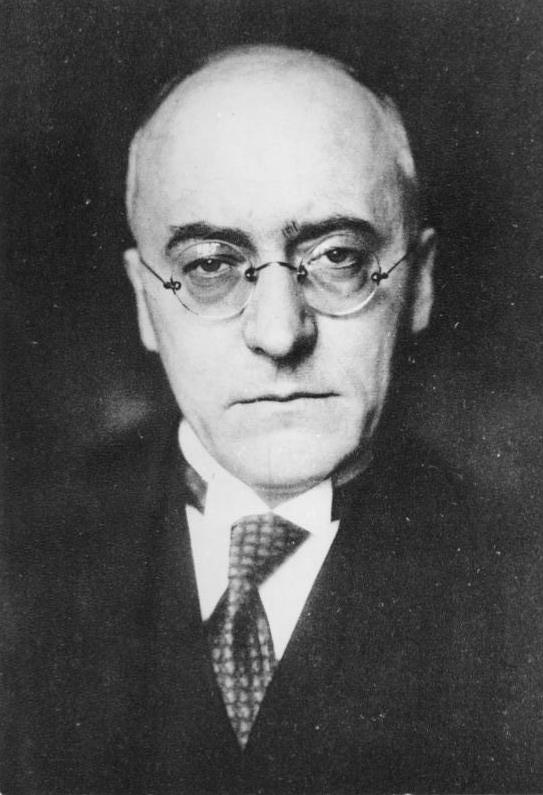
Saturday, 29 March 1930: Heinrich Bruening Forms a Government

Berlin:  New Chancellor Heinrich Bruening succeeds in forming a cabinet.  It is more nationalist-leaning than its predecessor, with Martin Schiele of the National People’s Party as Minister of Agriculture.  Seven of the ministers are holdovers from the previous cabinet.  

Friday, March 28, 2014

Friday, 28 March 1930

Berlin:  

President Paul von Hindenburg asks Heinrich Bruening, floor leader of the Centrist party, to form a cabinet.  And he’s given him 24 hours to do it, telling him to focus on constructing a cabinet that can get approval by the Reichstag, regardless of which parties it contains, and then can push through financial reforms necessary to get Germany’s financial house in order. 

Bruening is reportedly considering asking Martin Schiele to join his cabinet.  Schiele is a member of Alfred Hugenberg’s National People’s Party, the nationalist group that spearheaded the Liberty Law campaign.  By including Schiele in his cabinet, Bruening would be hoping to create a rift within the National People’s Party and divide their vote, possibly giving his government a better chance to succeed.  The nationalists, however, announce today that they won’t participate in a new Bruening cabinet, and demand that the Reichstag be dissolved and new elections held. 


Meanwhile, a scathing article by Gen. Erich von Ludendorff is published, in which he calls Hindenburg a “false hero” for signing the Young Plan.  Ludendorff says the world war veterans’ organization of which both he and Hindenburg are members should expel Hindenburg for “violation of duty.”  Ludendorff was a participant in Adolf Hitler’s “Beer Hall Putsch” in 1923 and a former Reichstag member, but he has been largely out of the public eye since 1928.  “Through four hard years, Hindenburg did what I told him to do,” Ludendorff writes.  “Now he has forfeited the right to wear the field-gray uniform or carry it to his grave.” 

Elsewhere:

Washington:  It’s all bad news on the economic front.  Retail sales through February in the United States are down 4% from same period last year.  And farm prices are at their lowest levels in 3 years – wheat the lowest in 17 years.

Thursday, March 27, 2014

Thursday, 27 March 1930: German Chancellor Hermann Mueller's Government Falls

Berlin:  

The “Grand Coalition” government of Chancellor Hermann Mueller falls.  Having held together long enough to see the Young Plan through, against growing financial pressure, it falls apart now over a disagreement about funding unemployment insurance.  Two of the political parties that make up Mueller’s government, the German People’s Party and the Social Democrats –Mueller’s own party – cannot agree on the matter, and the Social Democrats announce they are withdrawing. 

 The Social Democrats, representing primarily socialists, want to see unemployment insurance funded to the fullest extent possible, despite the cry from many in the populace for relief from taxes.  The German People’s Party, representing primarily industrialists, want to see the cost of funding the unemployment insurance reduced.  Mueller and many of the socialists were prepared to negotiate a compromise, but Rudolf Wissell, Social Democrat Minister of Labor, wouldn’t budge and led the withdrawal.  Mueller tendered his resignation to President Paul von Hindenburg shortly thereafter.

Unemployment benefits are costing Germany $300-400 million annually. 

Mueller’s cabinet has governed since June 1928.  Early speculation centers on Heinrich Bruening, a centrist, as a replacement.  Mueller himself has recommended him. 

The Mueller cabinet 

Elsewhere:

England:  More evidence of the worldwide economic depression: a new survey shows that 100,000 mill workers are unemployed in Lancashire.  Sources call it the worst economic depression in that part of the country since the 1860s.

 Tokyo:  The government still hasn’t replied to a U.S.-backed proposal from the London Naval Conference that Japan accept a 66-2/3 ratio of capital ships compared to the U.S. and Great Britain (which is less than the 70% Japan sought).  Sources say opposition to the reduced ratio from within the naval general staff is so fierce, the government is fearful of precipitating a crisis if it moves too quickly.  

Wednesday, March 26, 2014

Wednesday, 26 March 1930

Berlin:  Rumors swirl tonight that Chancellor Herman Mueller’s government may be in trouble.  Evidently, with the monumental task of the Young Plan measures’ passage now complete, the political parties that make up Mueller’s coalition government are disagreeing over some of the financial measures in its wake.  The head of the German People’s party is quoted as saying, “The chances for a breakup in the cabinet are great.”  Reichstag delegates have reportedly already begun asking President Paul von Hindenburg to name Heinrich Bruening, leader of the Centrist Party, to replace Mueller.

Tuesday, March 25, 2014

Tuesday, 25 March 1930

London:  More evidence of the growing worldwide economic depression – new government figures put unemployment at over 1.6 million, worst since 1922.  The National Unemployed Workers’ Movement announces plans for a jobless march, asking for government relief.

Washington:  Still more evidence of the depression -- unemployment among union members is at 21%, according to the American Federation of Labor.  That’s actually down a notch from 22% in February, but, “Improvement is not yet general,” says William Green, President of the AFL.  

Monday, March 24, 2014

Monday, 24 March 1930

Paris:  

In the case of White Russian General Alexander Koutiepoff, missing since allegedly being kidnapped in broad daylight January 30, a newspaper claims to have proof that he is in prison in the Soviet Union.  La Liberte writes, “We have awaited the moment when the secret service has received official confirmation of the above facts in order to make them public.  We can now affirm that Koutiepoff six days ago was alive in the Lubyanka jail in Moscow.”  An accompanying editorial urges the French government to sever relations with the Soviet Union over the incident. 

Geneva:  The tariff truce conference that opened here last month ends with 11 European nations agreeing to limited restrictions on their protective tariffs.  The hope is that this will stimulate the economies of Europe, most of which are trending downward in the worldwide depression.

Sunday, March 23, 2014

Sunday, 23 March 1930

Potsdam, Germany:  A mob of communists attempts to set free the inmates of a compulsory education school.  The facility director learns of their approach and calls the police, 22 of whom arrive armed with rifles.  120 communists are arrested.
 
Criuleni, Romania:  Authorities say they have uncovered a Russian spy plot after they arrest the municipal clerk of the town as he’s attempting to cross the Dniester River into Russia.  In his possession they find 500 forged Romanian citizenship certificates, a list of employees of the Romanian secret service, and a handful of confidential military documents.  The clerk says he got the materials from two officers in the Romanian military.  When police descend on one of the officer’s homes to arrest him, a gunfight erupts before he is arrested. 

London:  The worldwide economic depression worsens: government reports show unemployment is the worst since 1926, and still trending downward.

Saturday, March 22, 2014

Saturday, 22 March 1930

England:

London:  At the naval conference, a scheduled meeting between British Prime Minister Ramsay MacDonald and French Prime Minister Andrae Tardieu is cancelled, signaling definitively that France is out of the parley.  After two months of meetings, the conference is at a complete standstill – with nothing to show for its effort -- as Great Britain and the U.S. await word from Japan on whether a 3-way pact can still be signed.  Many in the press are saying the conference will have been a complete failure if Japan’s reply is negative.

Manchester:  More evidence of the Depression’s spread: an estimated 25% of cotton operatives in Lancashire are out of work, some so destitute they can’t get food to eat. 

Elsewhere:

Paris:  Finance Minister Paul Reynaud, in a committee speech, says that barring unforeseen circumstances, he expects France will remove all forces and end its occupation of the Rhineland by June 30.

Moscow:  Tens of thousands of demonstrators march for three hours here and in other cities around Russia in protest against religion.