Friday, October 4, 2013

Friday, 4 October 1929

Berlin:  

President Paul von Hindenburg names Julius Curtius Foreign Minister to succeed Gustav Stresemann, who died suddenly yesterday.  Curtius has been the Minister of Economics in the cabinet of Chancellor Hermann Mueller.


New York: 

Stocks fall again in the second-heaviest trading day of the year.  Over 5.6 million shares change hands.  A late rally holds losses to 1.4%, but the market is nervous after Thursday’s sell-off.

Manchuria:  


Reports say 250 Manchurian soldiers have been killed in the border clash with the Soviet Union over the last three days.  The battles are described as the worst yet in the conflict, which has run off and on since summer.

Elsewhere:  

China:  The civil war which has been raging off and on for two years is threatening to break out again.  A rebel army numbering 60,000 is said to be marching toward Canton.

Washington:  British Prime Minister Ramsay MacDonald begins a historic visit to the United States – the first ever by a sitting British prime minister.  

Belgrade: The Kingdom of the Serbs, Croats and Slovenes announces it will change its name to The Kingdom of Jugo-Slavia.


   

Thursday, October 3, 2013

Thursday, 3 October 1929: German Foreign Minister Gustav Stresemann Dies

Berlin: 

Foreign Minister Gustav Stresemann dies unexpectedly of a stroke.  He was 51.  The loss of the “greatest post-war statesman of Germany” is being called “irreparable.”  He helped negotiate reconciliation between Germany and France after the World War, for which he shared the 1926 Nobel Peace Prize with French Foreign Minister Aristide Briand.  He also helped negotiate the Young Plan.  Stresemann was a German imperialist and supported Germany’s annexation of territories from neighboring countries.  However, when the war went against Germany, he favored peace, and though he was reportedly shocked at the terms of the Treaty of Versailles, he believed Germany should honor them.  Streseman also twice served as Chancellor.


“In the chaotic conditions that gripped Germany for several years after the world war, Stresemann rose up as an antidote like oil on troubled waters,” says the Associated Press dispatch on his death.  Stresemann is credited with securing Germany’s renunciation of claims to the regions of Alsace and Lorraine, and navigating Germany’s entry into the League of Nations.

In fact, so great are the fears that his death might derail German foreign policy, especially Germany’s commitment to its debt payments from the World War (currently being renegotiated as part of the Young Plan), that President Paul von Hindenburg announces he will preside over a special cabinet meeting himself, and quickly name a successor.


Gustav Stresemann  Bundesarchiv, Bild 146-1989-040-27 / CC-BY-SA  Used under a Creative Commons Attribution-ShareAlike license: http://creativecommons.org/licenses/by-sa/3.0/


New York:

The worst drop of the year hits the New York Stock Exchange.  The market loses 4.2% -- 1.5 million shares trade in the final hour.  Traders have been predicting a drop since stock prices began a general decline nearly a month ago.  The market is now down 13% from its September record high of 381.  


Paris:  

An odd report from the diplomatic world: A certain M. Bessedowski, Charge d’Affairs at the Soviet Embassy, is seen leaping over a garden wall and running to the nearest police station.  There, he requests police to accompany him back to the embassy, for his own safety.  He says a GPU (soviet secret police) agent has threatened him with a gun.  “An agent sent from Moscow gave me a political examination because of my known anti-Moscow views.  He called me a heretic and ordered me to return to Moscow.  Knowing that would mean the firing squad, I refused.  Then the agent drew a revolver and tried to stop me from leaving the embassy.”  Police escort Mr. Bessedowski and his wife and child to the safety of a nearby hotel.

Wednesday, October 2, 2013

Wednesday, 2 October 1929

Moscow:  

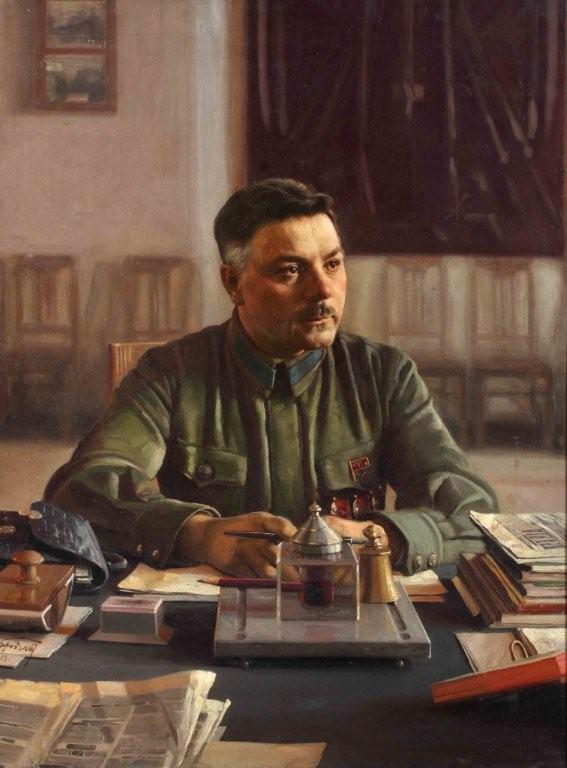
Klementi Voroshilov, Commissar of War, gives a bellicose speech before a regional trade union conference, in which he predicts that a massive war is coming between the “capitalistic” powers and the Soviet Union.  But he appears to welcome it, saying it will be the only way for the Soviet Union to deal with its enemies.  “In a future war, our air force working in collaboration with an immensely powerful artillery and utilizing chemical means of destroying life will play a decisive role.  The Red Army is already strong enough in all these branches to beat all its probable enemies, but considering that the enemy powers will be stronger industrially, we cannot rest content with the present munition supply either in respect to quantity or quality.  The foundation of the munition supply and technical power lies in the trade union movement.  The next war will be decided by workers in the factories, professors in the laboratories and students in the higher technical schools.”  


Nowa Slupia, Poland:  

A large but incidental fire destroys 70 houses and two synagogues . . . and reaches stores of explosives hidden in the basement of a building used for communist meetings, rocking the town with huge explosions.  Communists then cut the water mains to hamper fire control efforts, and attack firefighters and police with knives.  It takes 24 hours and the arrest of 11 communists to get the situation under control.  Five are killed and 100 more severely burned.  Police say the basement was being used as a supply center for communist militants in southern Poland. 


Lima:  

Meanwhile, allegations of communist agitation in Peru.  The newspaper La Prensa prints an article which says a communist plot against the government has been discovered in the army, and several officers are due to be court martialed as a result.  “A few subaltern officers as well as a comparatively considerable number of sergeants and corporals were arrested,” the article says.  


Tuesday, October 1, 2013

Tuesday, 1 October 1929: Great Britain and the Soviet Union discuss restoring diplomatic relations

Lewes, UK:  In a secretive meeting in this out-of-the-way town, British Foreign Secretary Arthur Henderson and Soviet Ambassador to Paris Valerian Dovgalevsky reach agreement on procedures for restoring diplomatic relations between their countries.  If successful, it will mark the first full diplomatic relations between the countries in two years.

The trouble began in 1927, when a letter from Grigory Zinoviev, head of the Communist International (Comintern) was found in a British trading house, which called for communist agitation in Great Britain.  The Conservative British government in power at the time accused the soviets of propagandizing in England (a charge the soviets denied, claiming they had no control over the Comintern), and broke off relations.  When a Labor government came to power earlier this year, interest in restoring relations renewed.  A sticking point, however, was that Great Britain wanted to negotiate solutions to the countries’ differences before exchanging ambassadors, whereas the Soviet Union wanted to exchange ambassadors first. 

So while the Labor Party holds a gathering at nearby Brighton, Dovgalevsky calls on Henderson, and the two drive here to get away from the hoopla and discuss terms.  Henderson agrees to the exchange of ambassadors, supposedly receiving in return a pledge that the Soviet Union will not propagandize in Britain.  This procedure will have to be approved by both countries, of course, but Henderson feels sure the Labor-controlled parliament will do so.  

Manzhouli, Manchuria:  Forces of the Soviet Union are reported to be carrying out attacks around this town in extreme northwestern Manchuria on the border with Russia, the entry point of the Chinese Eastern Railway.  The railroad runs through Manchuria but connects two points in Russia – the town of Chita in the west, and the port city of Vladivostok in the east.  Built by Russia in 1902 as a concession, the railroad by treaty is supposed to remain under the sole control of Russians.  Over the summer, however, Manchurian authorities began expelling soviet railway workers, reportedly out of fear they would spread communist propaganda.  A series of skirmishes ensued between soviet troops on one side of the border, and Manchurian forces on the other.  This attack, which breaks an extended quiet spell in the still-unresolved conflict, reportedly includes bombing runs by soviet warplanes.